SriLanka: March 2025
Sri Lanka had long been on my travel list, but political challenges had delayed my original plans. Determined to experience the country, I eventually adapted my itinerary, beginning in Colombo and then heading to the north-central region—the heart of the Cultural Triangle—where I stayed in Habarana. From there, I continued to the tea plantations and the vibrant city of Kandy, before returning to Colombo. Along the way, I explored fascinating museums, zipped through bustling streets on tuk-tuk adventures, marvelled at ancient cave temples and the iconic Sigiriya rock fortress, and enjoyed unforgettable elephant safaris and visits to sacred sites. My only regret? Amending my original plans—Sri Lanka left such an impression that I’m already eager to return.
Colombo National Museum - housed in a gleaming white, neo-Baroque building established in 1877, its founder was Sir William Henry Gregory, the British Governor of Ceylon (Sri Lanka) at the time.
The museum houses carvings and statuary from Sri Lanka’s ancient past, as well as swords, guns and other paraphernalia from the colonial period
The Sri Lankan elephants are the largest and also the darkest of the Asian elephants, with patches of depigmentation—areas with no skin colour—on its ears, face, trunk and belly.
The easiest way to distinguish Asian from African elephants is by looking at the ears. Asian elephants have much smaller ears than African elephants. Asian elephants are also smaller overall than their African counterparts, growing to around 7 to 12 feet in height and weighing between 6,500 and 11,000 pounds.
The herd size in Sri Lanka ranges from 12-20 individuals or more. It is led by the oldest female, or matriarch.
I was fortunate to be paired with a great guide and an even better driver, who has over 29 years of experience navigating the jungle. We tended to take the less beaten track (kind of like my norm), and it led to seeing so many elephants
Elephants eat 10% of their body weight each day, which for adults is between 375 and 450 pounds of food. They need 21 to 53 gallons of water a day and use more for bathing.
Located in central Sri Lanka, the Rangiri Dambulla Cave Temple is a living Buddhist site that is focused on a series of five cave shrines.
A sacred pilgrimage site for 22 centuries, this cave monastery, with its five sanctuaries, is the largest, best-preserved cave-temple complex in Sri Lanka.
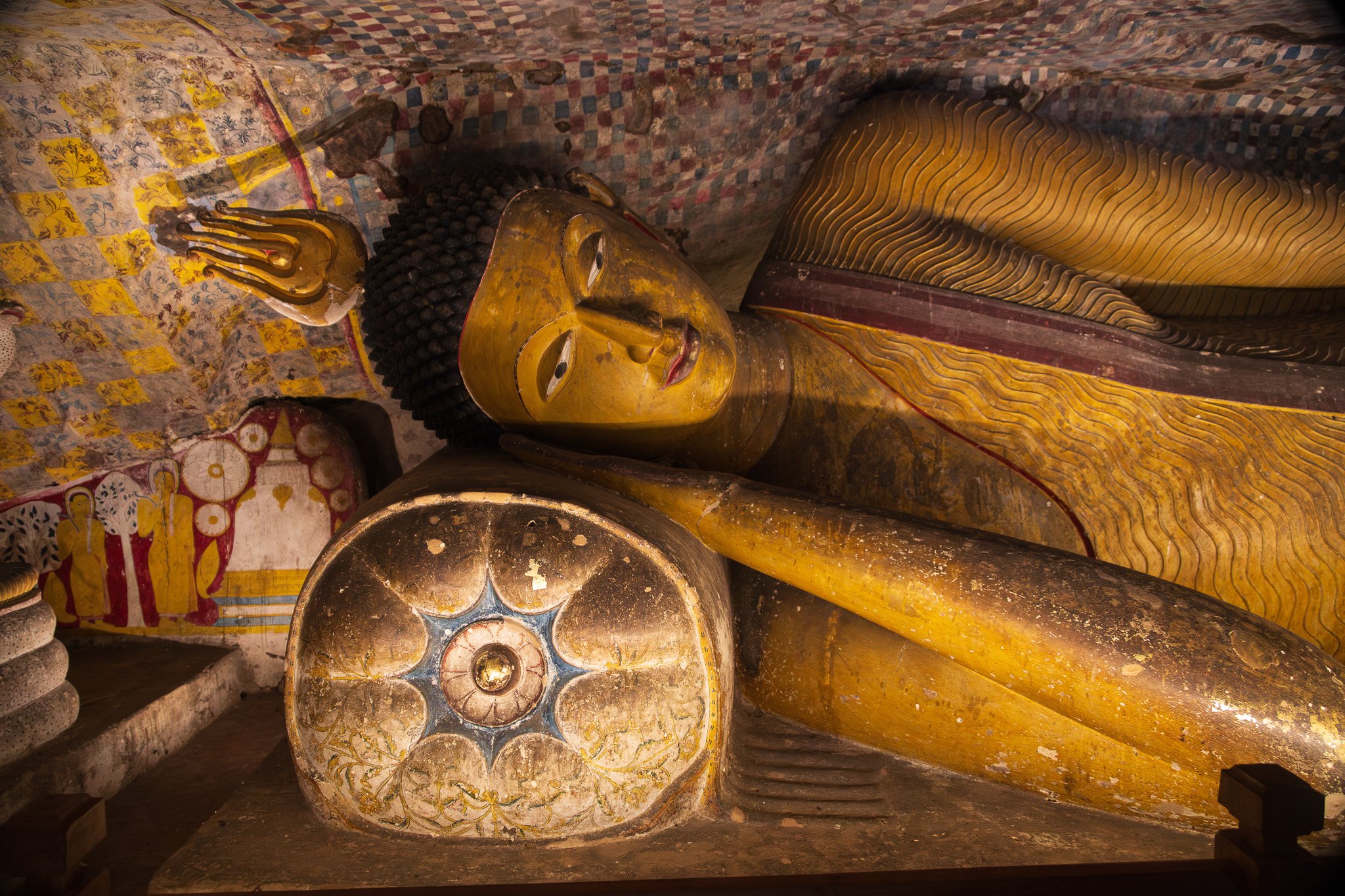
The large 45 feet Sleeping postured Buddha statue is said to be the Parinirvana status or the final passing away of the Lord Buddha.
The Cave of ' Great Kings '. The Stupa in this temple surrounded with eleven seated Buddha images
The Buddhist mural paintings (covering an area of 2,100 m2 ) are of particular importance, as are the 157 statues.
Dating back to the 1st century BCE were used as a Buddhist monastery. There are over 150 Buddha statues in various postures and statues of gods and kings.
Depictions of reclining Buddhas in cave temples generally signify the Buddha's passing into Parinirvana, his final state of enlightenment and death.
All the statues have elongated earlobes. Some scientists say they symbolize the ability of absolute listening and perceiving, the others pointed out that Buddha was born and lived the first part of his life as a prince and only rich and noble people were allowed to wear jewels.
This cave was constructed by the King Kirti Sri Rajasinha (1747-1782 AD ) who ruled in Kandy.
Each Buddha has one of seven different hand positions representing an aspect of Buddhism teaching. The reclining Buddha is the final moment before enlightenment after death.
Sigiriya aka the Lion Rock
This is the ancient rock fortress nearly 200 meters high. King Kasyapa (477-495 CE), who chose this site as his new capital. He decorated the walls with frescoes, and built a palace right on top of the rock column accessible through the mouth of the lion, over the paws.
The paws at Sigiriya, part of the Lion Staircase, were remarkably large, with remnants suggesting fingernails as tall as a human.
There are 1200 steps to the top and 900 to the lion paws. That's where I got to. The thought of going higher in the heat wasn't for me. But I was pleased to get to where I did and make it back down again!
This temple is visited by thousands of local & foreign devotees and tourists daily, and was named as a world heritage by UNESCO in 1988.
It’s said that the Sacred relic was brought to Sri Lanka by Princess Hemamala & Prince Dantha from the city of Kalinga in ancient India.
Protecting of the Sacred Tooth Relic and conducting religious rituals without a break is being carried out to the present day under the strict surveillance of the three chief custodians of the Tooth Relic.
Offerings include items that symbolize respect and reverence, such as flowers, incense, and food. These offerings are a way for devotees to express their gratitude and connection to the Buddha.
Paintings depicting the annual festival featuring a grand procession involving hundreds of decorated elephants, dancers, drummers, and other performers, all parading around the city to honour the Sacred Tooth Relic.
James Taylor, a Scottish coffee planter, planted the first 19 acres of tea in Loolecondera Estate near Kandy. This marked the beginning of the tea industry in SriLanka.
The Ceylon Tea Museum is located in the former Hanthana Tea Factory, which was originally constructed in 1925.
The ground floor houses 19th century colonial generators, rollers, dryers, fermentation tables, sorting machines, etc. The second floor houses the library and museum. The third floor has a shop and a place to try some tea.
Ceylon tea became a major export crop for Sri Lanka, contributing significantly to the country's economy.
Meet Douglas—the tuktuk driver on YouTube!
How do you choose a tuktuk driver? If you’re me, you go with the guy who confidently tells you he’s on YouTube 😆. So off we went, weaving through the lively, crowded streets of Pettah Market—honking, dodging, and speeding through the chaos like pros. 🚦🛺💨