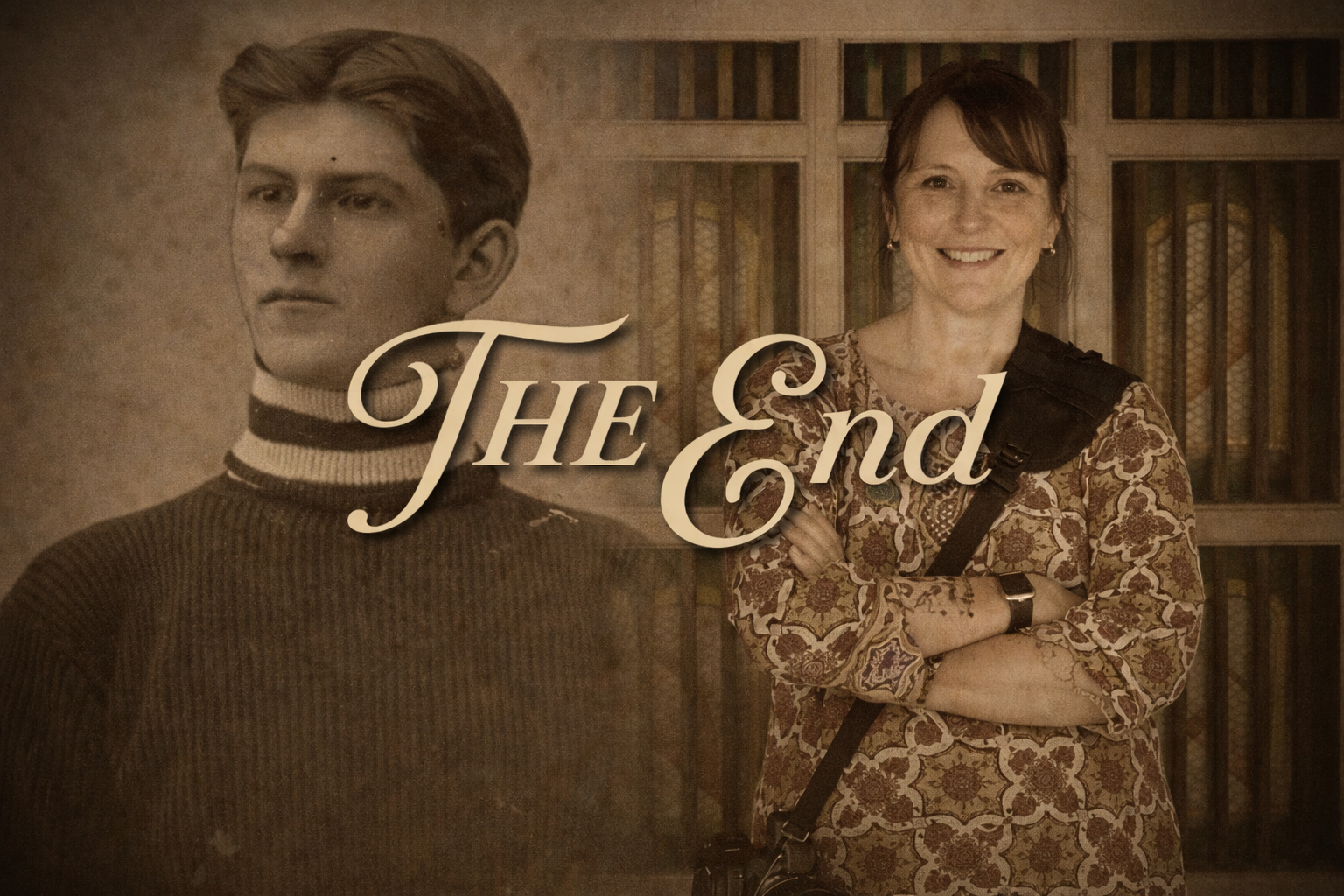
Legacy is a layered word. It can mean children and family lines, but it can also mean stories, traces, an imprint, or an impact. Karl left behind descendants who carry his name, along with relatives however distantly connected — and a trail, big enough that a stranger, 120 years later, could stumble across it on a mural wall and feel compelled to learn more.
Central to that legacy is his accomplishment as the first Canadian to wheel around the world, a feat that ensured his story would be recorded, remembered, and woven into the broader history of cycling and travel.
Karl’s journey can be found in various books, including:
• William Humber, Freewheeling: The Story of Bicycling in Canada (1986)
• Brian F. Kinsman, Around the World Awheel (1993)
• Sharon Babaian, The Most Benevolent Machine (1998)
• Glen Norcliffe, The Ride to Modernity (2001)
• Robert L. McCullough, Old Wheelways (2015)
• Wim Daniëls, Het wonderbaarlijke verhaal van een stille avonturier (2023)
Each book places Karl within a different frame: cycling history, global adventure narratives, and the evolution of travel. Yet all recognize his remarkable achievement.
Beyond the bookshelves, Karl’s story turns up in smaller corners of the world: cycling websites, museum newsletters, antique bicycle circles, and local histories. Each acknowledgement offers a slightly different angle, and together they show how far Karl’s story reaches beyond Nova Scotia.
In 2016, I first saw the mural depicting Karl. Soon after, I found Brian Kinsman’s Around the World Awheel, which laid out his journey in extraordinary detail. Not long after that, I wrote to Brian and later sat with him over coffee while he shared his research with me. He was as captivated by Karl as I have been, and while some may wonder why I undertook this journey when Brian had already documented so much, my mission was complementary: not just to recount Karl’s journey, but to travel alongside it, to stand where he stood, to see what remains, to photograph the traces, and to place his travels in a broader historical context.
Over the last nine years, this project has shaped how I travel, how I understand history, and how I see my role as both storyteller and photographer. It has given me a clearer sense of who I am, what I can contribute, and how I want to spend my time and energy in the years ahead, in what will become my legacy.
But this project has never been a solitary one. My partner, Naveed, has edited every Chronicle, approaching the work with care and rigour, paying close attention to the language, the structure, and the details, always focused on getting it right. He has listened as I talked, often incessantly, about Karl, working through discoveries and itineraries, and steadied me through moments of doubt as I devoted so much time, energy, and resources to this personal project and its long stretches of travel. His consistent and patient support allowed me to move beyond documentation and into a deeper understanding of the journey itself.
Karl’s world, in many ways, was one of ships, letters, railway tracks, and colonialism — the height of the British Empire — marked by conflicts like the Boer War and the Boxer Rebellion, along with outbreaks of disease and early pandemics. Mine is one of flights, cars, online bookings, changing borders, a digital revolution, and a world still marked by wars and pandemics. Yet following Karl, I’ve felt a thread connecting us: curiosity, restlessness, determination, perseverance, a touch of boldness (and naïvety), and the shared desire “to have a look around and gain a bit of experience.”
As I wrap up my Chronicles, I’ve been fortunate to see this project ripple outward, through news articles, museum talks, private presentations, and even a radio interview or two. I have submitted an application to the Secretariat of the Historic Sites and Monuments Board of Canada (HSMBC) for Karl to be recognized as a Historical Person, not only because he was the first Canadian to bicycle around the world (remarkable as that accomplishment is), but because his story captures something larger: a moment in Canadian social history when international travel and self-directed exploration became accessible to working-class Canadians through new technology, determination, and initiative. My nomination presents Karl not only as the first Canadian to complete a global cycling journey, but as a representative figure who typifies the democratization of travel and social mobility at the turn of the 20th century.
If Karl is recognized, I’ll be delighted. If he isn’t, I’ll still be glad I tried. Either way, through this journey, his story has reached more people, and his legacy has become intertwined with my own. The importance of any journey isn’t only in the destination, but in how it changes you along the way.
I will soon begin drafting a manuscript of my adventures following Karl, not simply a retelling of the Chronicles, but a more reflective narrative of what that journey has done to my own sense of place and belonging. I am also planning a collection of prints titled Karl’s Travelography, which I hope will be ready for Spring 2026. I’ll share updates through this email list and on social media when there’s real news to share, perhaps a publisher found, or an exhibition confirmed.
Next week, you’ll receive a final email with a link to the full index of all 255 Karl Chronicles, a guide for anyone who wants to wander back through the journey or discover it in their own order.
Looking ahead, I’m also feeling the tug of new roads. Karl’s journey may be complete, but I’m not done travelling or telling stories. Karl has helped me find my voice, my purpose, and my passion. I’m planning to gently transition you, dear reader, into a new group email called GlobeTrotter Tales, monthly stories from places I’ve travelled (and will travel to), where history, geography, and human quirks collide. I’ll invite you along, and you can decide if you’d like to stay on the road with me.
But for this final Karl Chronicle, I want to pause and say thank you, dear reader. Thank you for opening these emails, for reading along on dark winter mornings and bright summer ones, for sending notes, questions, and family stories of your own, and for making Karl’s journey feel less like history and more like a shared adventure.
Karl may have started his journey with three cents in his pocket. I started mine with a mural and a lot of curiosity. The real wealth, for both of us, has been the company we kept and the moments we shared along the way.
As Paulo Coelho writes in The Alchemist, “when you want something, all the universe conspires in helping you to achieve it.” I like to think Karl would agree.